A Retrieval-Practice Reading Journal for Nonfiction Book Groups
A lively book discussion can make an argument feel familiar without leaving anyone able to explain it a week later. A reading journal can help if it includes a moment when the book is closed and the reader reconstructs an idea. That moment is retrieval practice. It works differently from copying an attractive passage or highlighting a sentence while it remains in view.
The following routine is designed for an informal nonfiction group. It uses a few questions and a correction column, with room for disagreement. The journal is a conversation aid, not a scorecard for deciding who read most carefully.
Choose one idea worth remembering
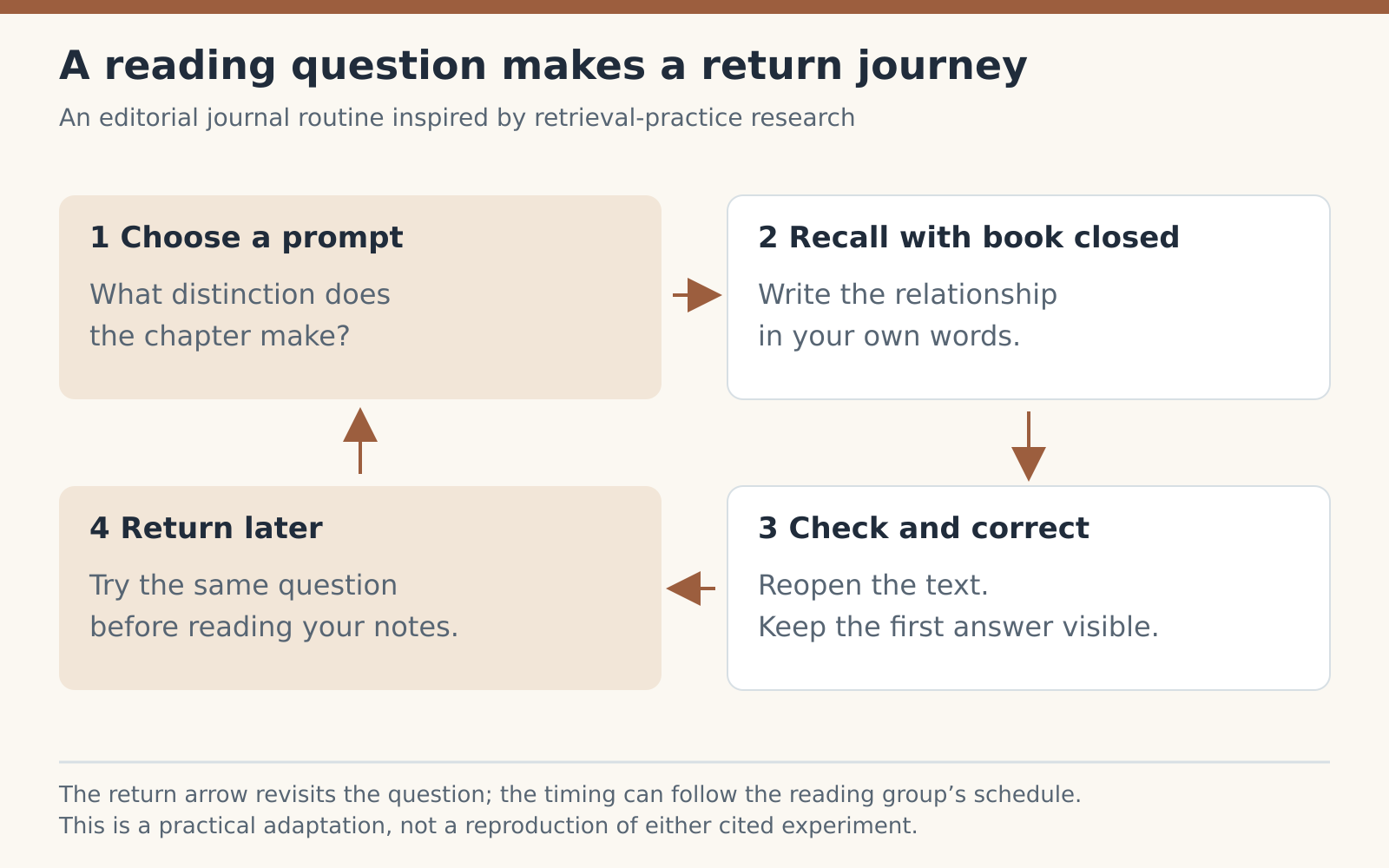
Begin with a manageable unit: a chapter, an essay or a short section of a demanding book. Choose a question about its central reasoning. “What distinction does this chapter make?” is usually more useful than “What happened on page forty?” The question should be answerable without reproducing the author’s wording.
For an invented chapter about city gardens, a suitable prompt might be: “Why does the author distinguish access to green space from actual use?” This asks the reader to recover a relationship. A second prompt might ask for one example and one limitation. Three well-chosen prompts can support a richer discussion than a page of isolated facts.
Write the prompts before closing the book, but leave the answers blank. Avoid making the wording so detailed that it contains the answer. A useful cue points toward an idea while still requiring the reader to reconstruct it.
Close the book before writing the first answer
Write a brief answer from memory. It can be incomplete. Use a question mark for an uncertain detail rather than filling the gap with a plausible invention. This first attempt reveals which connections are available without the page providing constant hints.
In Roediger and Karpicke’s study of learning from prose, participants who practiced recalling material performed better on delayed tests than participants who repeatedly studied it, although repeated study helped on an immediate test. The useful lesson for a reading group is to distinguish feeling fluent now from being able to recover an idea later.
The journal routine here is an editorial adaptation, not a reproduction of that experiment. A book group has different texts, motivations and outcomes. The study supplies a reason to include retrieval; the practical format should remain flexible enough for readers who need more time or prefer speaking an answer first.
Check the answer and preserve the correction
Reopen the text and compare the memory answer with the relevant passage. Add a correction in a separate column. Keeping the original attempt visible is helpful because it shows the nature of the gap: a missing qualification, a reversed comparison or an example mistaken for the main claim.
| Prompt | First recall | Correction after checking |
|---|---|---|
| Access versus use? | More nearby parks means more use. | The chapter distinguishes availability from barriers that affect use. |
| One limiting condition? | Unsure. | Add the condition actually discussed, with a page reference. |
| Question for the group? | Would a local survey answer this? | Keep as an open question, not a reported finding. |
These entries are fictional. The pattern matters more than the topic: remembered claim, checked correction and unresolved question occupy different spaces. A polished summary written only after reopening the book would conceal the first two stages and make it harder to see what needs another attempt.
A page reference is enough for a private notebook. If the group shares notes publicly, paraphrase rather than copying long passages, and identify the book and edition. A short note should help someone return to the text instead of pretending to replace the original reading.
Add an explanation prompt, not only a fact prompt
Remembering a term is different from explaining how an argument works. Add a question beginning with “why,” “how” or “what would change if.” For the invented garden chapter, ask what observation would distinguish a lack of access from a lack of use. The answer should connect the chapter’s concepts to an example.
Karpicke and Blunt’s retrieval-practice study examined learning from science texts and included questions requiring comprehension and inference. It supports considering retrieval as more than vocabulary rehearsal. It does not establish that concept maps or discussion are useless; those activities can serve purposes beyond the comparison tested in that experiment.
A group can therefore combine methods. First attempt an explanation from memory, then draw a shared map while checking the text. The sequence makes it easier to see which connections readers generated independently and which emerged through rereading or conversation.
Return to the question after some time has passed
At the next meeting, revisit one earlier prompt before reviewing the notes. Do not seek perfect wording. Look for the same relationship, its main qualification and an example that still fits. The practical aim is a usable understanding rather than an exact transcript of a previous answer.
Keep the timing realistic for the group. A recurring meeting provides a convenient opportunity, but this routine does not claim that one interval is optimal for every book or reader. If a difficult concept has disappeared completely, shorten the passage and improve the cue before simply demanding more effort.
Separate confidence from completeness. A reader may feel uncertain while giving an accurate answer, or feel very sure while missing the chapter’s key qualification. Checking both against the text keeps the journal focused on evidence rather than self-judgment.
Use the notebook to improve the conversation
Invite each reader to bring one recovered idea, one corrected misunderstanding and one open question. This gives quieter participants a prepared starting point and makes correction a normal part of reading. Nobody needs to disclose a private score or compare the length of their notes.
When the group moves into health or neuroscience books, preserve the same distinctions. What did the text claim? What evidence did it describe? What did the reader infer? Those questions become especially useful when a memorable story about learning introduces a molecule or a brain experiment.
Keep questions about interpretation distinct from questions about textual accuracy. Two readers can remember the same argument correctly and disagree about its merits. The correction column should repair a misstatement of the book, while the discussion column remains open to competing judgments.
End a meeting by choosing the next question together. A useful journal grows through a sequence of small, revisitable explanations. Its value lies in making understanding easier to recover and revise, while leaving the pleasure of reading and disagreement intact.








 One of the most important hormones you may require for the growth and maintenance of the body is Testosterone. It is the hormone secreted by the make body during their life. But with the increase in age, the level of testosterone starts decreasing and treating that low testosterone level; you need to get TRT. TRT basically stands for Testosterone Replacement Therapy. If you get this therapy, it will enhance your sexual performance and help you achieve a higher level of energy.